

TRUST ALLIED WITH YOUR PREVENTATIVE MAINTENANCE
Preventative Equipment Maintenance
A small problem caught early beats an expensive breakdown every time, and that’s the whole idea behind planned maintenance: keeping equipment running at its best for longer instead of waiting to react when it fails. It’s one of our most requested services for exactly that reason.
 300+ Manufacturers Serviced
 Certified on 300+ Manufacturers
 90 Day Parts and Labor Guarantee
OUR APPROACH
We Skip the Out of the Box Program. Instead, We:
Treating a customer’s business like our own is part of how we operate at Allied Service Group. Technicians are trained to recommend only the service equipment actually needs, nothing more.
SIMPLE, FAST, RELIABLE
How Planned Maintenance Works
Here’s the path from enrollment to your first scheduled visit.

Call or Request Online
Reach out by phone or online to talk through enrolling your equipment. Nothing has to be broken first.

Custom Program Built
We design a program around your equipment, how it’s used, and your budget, whether that’s one unit or the whole kitchen.

Scheduled Service Visits
Your technician shows up as planned for preventive checks, including safety inspections for wiring, cords, and gas connections, plus whatever service the equipment needs that day.

Test, Document, & Follow Up
Every visit gets documented so you have a clear record, and we keep your program on schedule going forward.
THE ALLIED DIFFERENCE
Why Choose Allied Service Group For Planned Maintenance?
A maintenance program is only as good as the company running it. Here’s what makes Allied Service Group different.

Highly-Skilled Technicians
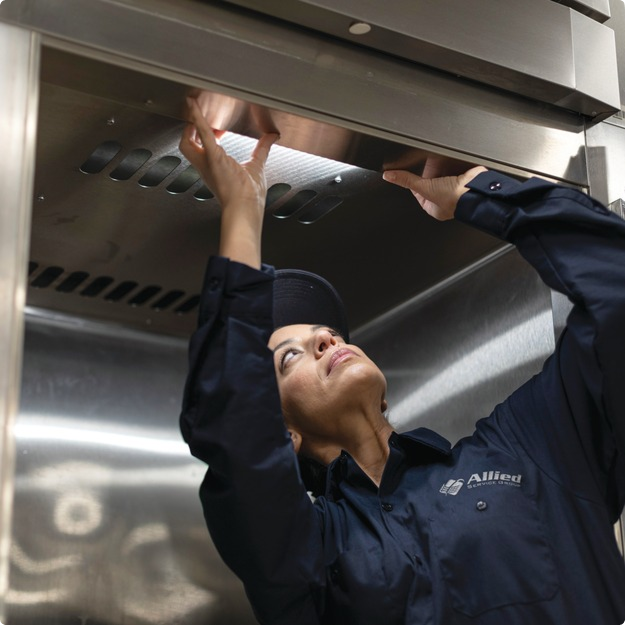
Technicians train continuously across cooking, refrigeration, beverage, and HVAC equipment, not just once at hire.

We Stock the Most Commonly Used Parts
Genuine manufacturer parts, the ones actually needed most, ride in our trucks. Factory spec only, never a generic substitute.

90-Day Guarantee
Parts and labor are both covered for 90 days on every visit, and our fleet runs on GPS routing so a technician is rarely far from where you need one.

Thorough, Multi-Point Inspections When You Need It Most
Getting ready for an inspection? We go past a quick look, burner inspection, thermostat calibration, gasket checks, gas pressure testing, and a real cleaning.

All Fuel Types & Configurations
Gas, electric, LP, or dual fuel, every configuration gets serviced. Technicians train on atmospheric and infrared burner systems across every major brand.
High
High
High
High
Medium
Medium
Medium
Low
FREQUENTLY ASKED QUESTIONS
Preventative Maintenance FAQ
Answers to the questions we hear most about planned maintenance. Don’t see yours? Give us a call.
Catching small issues before they become expensive repairs or full breakdowns is the core value. Customers on a planned maintenance program typically see fewer emergency calls and more predictable costs overall, since scheduled maintenance is planned and budgeted rather than an unplanned expense that hits without warning.
Yes, we handle planned maintenance programs for single locations and multi unit operators alike, anywhere across our Mid-South service area.
Every visit includes safety checks like wiring, cords, and gas leak inspection, plus service specific to your equipment: burner inspection, thermostat calibration, gasket checks, gas pressure testing, and thorough cleaning. The exact scope depends on what’s on your program.
We start with a conversation about your equipment, how heavily it’s used, and your budget, then build a program with the frequency and scope that fits, whether that’s a few key units or your entire kitchen. Equipment running harder generally needs more frequent visits than equipment used lightly.
Yes. All work is backed by the Allied Service Group guarantee, 90 days on parts and labor.
Entirely up to you. Programs can cover a single piece of equipment, a category like refrigeration, or your whole kitchen. Many customers start with their highest use or highest risk equipment and expand from there.
PREVENTATIVE MAINTENANCE
Stop Breakdowns Before They Start.
A planned maintenance program from Allied Service Group means fewer surprise breakdowns, lower repair bills, and equipment that lasts longer. If something comes up between visits, the same skilled technicians and 24/7 dispatch are ready to handle it.